
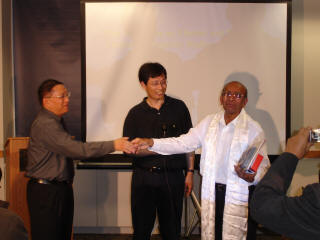
Professors from the China Tibetology Research Center in Beijing, will share their research on various aspects of Tibetan culture and Buddhism:
Du Yongbin – Tibetan Studies in Contemporary China: The Styles and Characteristics
Tibetan studies is a discipline both about geography and society of Tibetan areas, and about history and today of the Tibetans. China is the hometown of Tibetan studies, and Tibetan studies in China have a long history.
Entered into modern times, particularly, the term Tibetology was created by Hungary Tibetologist Cosma since 1830s,Tibetan studies had been considered as an independent discipline from humane studies, and it become a popular discipline in the world.

Dawa Cairen – Present day Tibetans’ views on reincarnate lamas
Tibetan reincarnate lama has already existed for more than eight hundreds years. The reincarnate lama is the highest religious practitioner in Tibetan Buddhism. An incarnate lama is someone that has gone through the process of reincarnation in order to carry on the religious status and position of the reincarnate lamas.
This article relies on a combination of questionnaires and interviews in an attempt to understand present day Tibetans’ basic opinions of and attitudes towards reincarnate lamas.
This study employs survey and intensive interview as its data collection methods to investigate Tibetan’s general perspective on and attitude to reincarnate lamas. reincarnate lama is a special group among Tibetan religious elite. In fact, there are at least three aspects of reincarnate lamas research: Institutional research, identification research and social impact research. The content I am going to talk to you today is basically an identification or recognition-level research.

Zhou Wei – Tibetan Legislation on Tibetan language and Its Linguistic Rights and Interests Protection – A Comparative Study with European Legislation on Minority Languages China Tibetology Research Centre
The legislation on Tibetan language, as an important part of Chinese legislation on minority languages, is not only closely related to the development of Tibetan society and Tibetan language status, but also to “Constitution of the People’s Republic of China”, “Law of the Peoples Republic of China on Regional National Autonomy”, “Law of the People’s Republic of China on the Standard Spoken and Written Chinese Language” and Chinese policies on minority languages. The policy on Tibetan language has its own ethnic features but also represents the characters of Chinese policy on all of the other minority languages.

Deji Droma – The Practice of Tibetan Buddhist Nuns
In the long course of human history, each area and nation has its own different religious Life-style and their different manifestation in different times. After Buddhism entered Tibet, it had chosen its existence in the process of Tibetanization. As the religious females and women practitioners who acted as one of vehicle spreading and implementing Buddhism, they had set up their optimal value of life and religion behavioral pattern ,with distinctive individuality.
The paper will illustrate the practice of the Tibetan Buddhist nuns from 3 aspects.


