
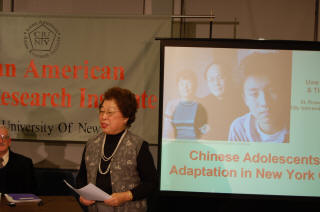
This presentation is a preliminary report of our ongoing research project on the adaptation of 150 Chinese-American youths to the living environment in New York City. Following Sung’s (1987) groundbreaking study, we have attempted to address similar issues with a focus on the psychological factors that mediate sociocultural and behavioral variables. To serve this purpose, new research instruments were developed, including a Background Questionnaire for collecting basic information about the participants, a semi-projective Sentence Completion Test, and a semi-structured Qualitative Interview composed of 41 open-ended questions about the interviewees’ self-image, their identities as Chinese Americans, their family situation, their view of gender roles, attitudes toward family, peers, friends, school, and teachers, extracurricular activities, homework, and dating practices.
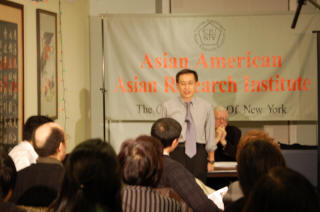
Participants’ responses gathered so far suggest that 1) in spite of the relatively low socioeconomic status and frequent English language problems in their families, many Chinatown youths have fought against all odds to become academically successful; 2) Chinatown youths’ success can be attributed to a large extent to the core cultural emphasis on education which is deeply rooted in Confucianism as well as a perennial sense of predicament; 3) due to the difficulty of adjusting to the American-dominated system, a considerable number of Chinatown youth made different life-course decisions to drop out of school and turn toward various forms of underground business.

The participants report that many of their parents are following relatively traditional childrearing practices, such as emphasizing children’s obligations toward their family together with sustained efforts to succeed academically. The parents rarely employ positive reinforcement vis-à-vis their children and typically do not display overt signs of affection. Many youths indicate a deep sense of indebtedness toward their parents who work very long hours and have made numerous sacrifices to ensure the well being and positive future of their children.
We conclude that Chinatown youths are traditional in the sense of maintaining the living (and functional) faith of their ancestors but that they refuse to endorse the more barren and non-adaptive forms of Chinese traditionalism.
Online Notes


